
Before Contact in the Desert: The Giant Rock Spacecraft Conventions
Jun 07, 2026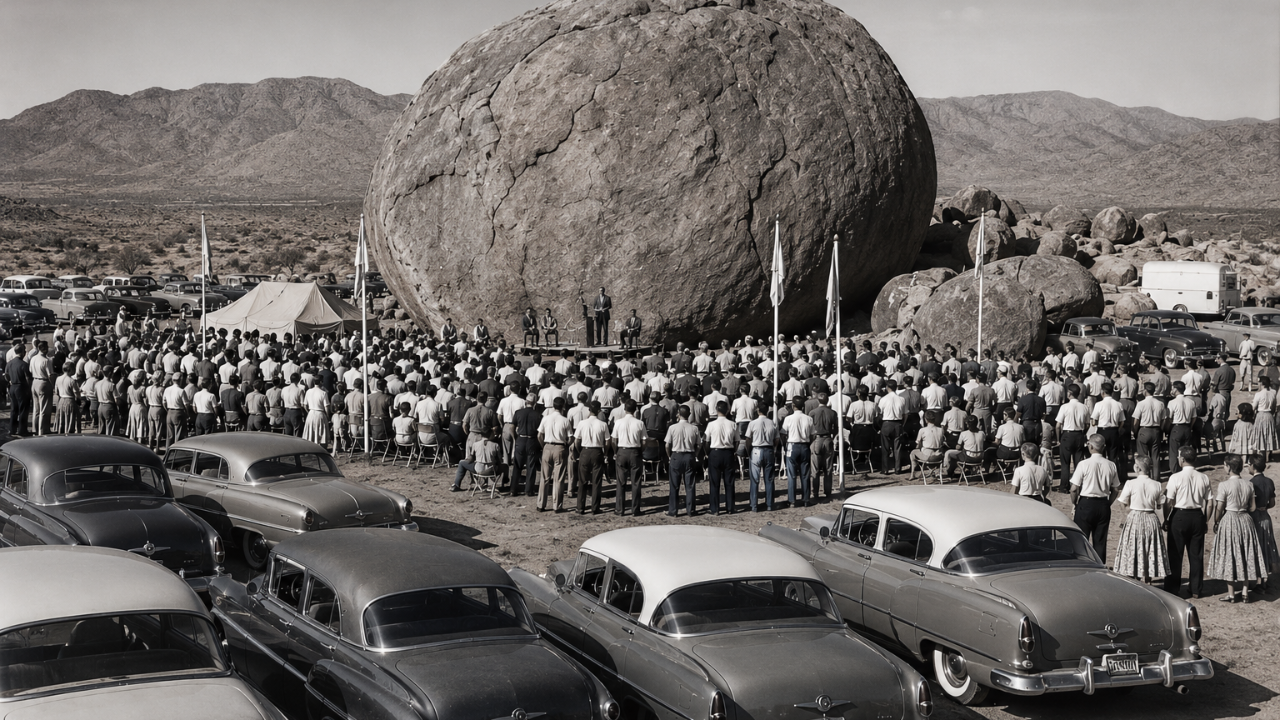
Every year, thousands of people travel to the California desert to attend Contact in the Desert. They come hoping to hear the latest theories about UFOs, government secrets, ancient mysteries, and the possibility that we are not alone in the universe. To many attendees, it feels like a modern movement. Yet long before modern UFO conferences, podcasts, and streaming broadcasts, people were already making a similar journey into this same desert, searching for answers beneath the stars.
About thirty miles north of Palm Springs sits a remote stretch of land near Landers, California. Today, visitors passing through the area often stop to see the Integratron, a large white dome that has become one of the most recognisable landmarks in UFO history. What many do not realise is that this quiet desert location was once the centre of one of the largest UFO movements in America.
Much of Giant Rock’s UFO history can be traced back to George Van Tassel. He had worked in aviation and spent time around some of the biggest names in the industry before settling in the Mojave Desert. During the 1940s he became caretaker of Giant Rock, an enormous freestanding boulder that rises from the desert floor. For years, Giant Rock served as a gathering place for travellers, prospectors, and people interested in unusual ideas. Under Van Tassel’s care, it became something else entirely.
Giant Rock already had a reputation before Van Tassel arrived. During the 1930s and early 1940s, it became known through the story of Frank Critzer, a desert dweller who built a series of underground rooms beneath the massive rock and lived there for years. In 1942, Critzer was killed during a confrontation with authorities investigating rumours of espionage. The unusual story became part of local desert folklore and helped give Giant Rock an air of mystery long before it became associated with flying saucers and extraterrestrials.
According to Van Tassel, everything began on August 24, 1953. He claimed he was awakened around two o’clock in the morning by a strange vibration. Outside, he said, he encountered a spacecraft and was invited aboard by a being named Solganda, who claimed to be from Venus. Over the years, Van Tassel gave different versions of the story, but he consistently maintained that the encounter marked the beginning of ongoing communication with visitors from beyond Earth.
Van Tassel later said the encounter was not simply a sighting but the beginning of an ongoing relationship. He claimed he received messages from extraterrestrial visitors warning about humanity’s future, the dangers of nuclear weapons, and the need for spiritual and technological advancement. According to Van Tassel, these communications continued for years and eventually influenced both his public lectures and his plans for the Integratron.
During the 1950s, many contactee stories featured visitors from Venus, Mars, and other nearby worlds. At the time, scientists knew far less about the conditions on those planets than they do today, making such claims seem more plausible to some members of the public than they might appear now.
Today, the story sounds extraordinary, even by UFO standards. Yet it arrived during a period when America was fascinated by space, atomic technology, and the possibility of life beyond Earth. The Cold War was underway. Reports of flying saucers filled newspapers across the country. Millions of people looked toward the skies and wondered whether something unknown might be out there.
What began as small gatherings near Giant Rock gradually grew into something much larger. By the late 1950s and early 1960s, thousands of people were travelling into the desert to attend what became known as the Spacecraft Conventions. Witnesses described long lines of vehicles stretching across the desert. Families camped beneath the stars. Vendors sold books and magazines. Speakers discussed UFO encounters, extraterrestrial contact, lost civilizations, free energy, and theories about humanity’s future.
For a few days each year, one of the most isolated locations in California became the centre of the UFO world. Attendance continued to grow. Some reports suggest the largest conventions attracted more than 10,000 visitors, an extraordinary number considering the remote location. Long before social media, YouTube channels, or podcasts dedicated to disclosure, people were travelling hundreds of miles into the desert to hear the latest claims about flying saucers and alien contact.
At its peak, the Giant Rock conventions were among the largest and most influential UFO gatherings ever held. For a time, the centre of the flying saucer movement was not Washington, New York, or Los Angeles. It was a remote patch of California desert surrounding a giant boulder.
For many attendees, the trip became an annual tradition. Families returned year after year, setting up camp beneath the desert sky and listening to speakers from morning until late into the evening. Some came hoping for proof. Others came for the sense of community. In an era before the internet made it easy to find like-minded people, Giant Rock offered something many visitors could not find at home: a place where discussions about UFOs and extraterrestrial life were not considered unusual.
While the conventions are long gone, the Integratron still stands in the desert. Van Tassel claimed the design was inspired by information he received from extraterrestrial sources. He believed the structure could eventually be used for rejuvenation, healing, and advanced energy research. He also claimed its design incorporated principles shared during his communications with visitors from space.
Construction began during the 1950s and continued for years. The building was never completed according to Van Tassel’s original vision, but the distinctive dome remains one of the most recognisable landmarks in UFO culture. Today, visitors travel from around the world to see the structure and hear the story behind it. Whether visitors view it as a scientific experiment, a monument to belief, or simply an unusual piece of desert history often depends on their perspective.
The crowds are gone now, but the story remains. Most never saw a spacecraft land. No revolutionary technology emerged from the desert. The answers they were seeking remained frustratingly out of reach. In many ways, Giant Rock was Contact in the Desert before Contact in the Desert existed. People travelled into the California desert to hear speakers discuss UFO encounters, alien contact, government secrecy, advanced technology, and humanity’s future. The topics have evolved over the decades, but the basic idea remains remarkably familiar.
That may be why Giant Rock continues to hold a place in UFO history. The story is not really about proving whether George Van Tassel encountered visitors from another world. It is about the people who travelled into the desert searching for answers, and the people who continue to do so today.
Walking through Contact in the Desert for the first time this year, it was hard not to notice how familiar some of the conversations sounded. The speakers are different, the setting is different, but many of the questions are the same ones people were asking at Giant Rock more than half a century ago.
Like many of those early attendees, I left with more questions than answers. I also left knowing that I will be back next year.
More than seventy years later, the questions that brought people to Giant Rock remain unanswered. Whether George Van Tassel really communicated with visitors from another world is something you will have to decide for yourself. What cannot be disputed is that thousands of people travelled into the desert searching for answers, and people are still doing exactly the same thing today.