
Before Fortean: Robert Kirk and the Unexplained in the Scottish Highlands
Apr 16, 2026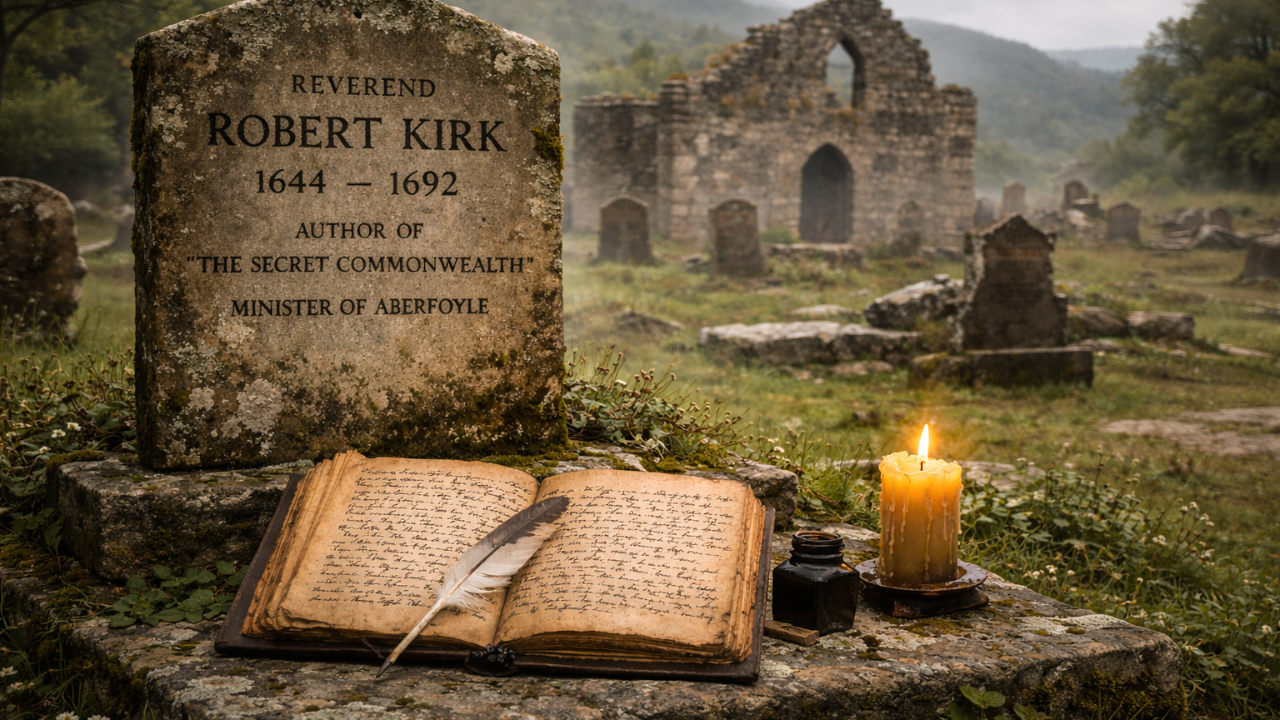
Most people point to Charles Fort when they think about the paranormal being investigated. His name is tied so closely to the subject that it became its own label. Fortean. Strange phenomena, unexplained events, the kind of cases that still don’t have clear answers. But he wasn’t the first to investigate the unexplained.
More than two hundred years earlier, in the Scottish Highlands, Robert Kirk was already writing about encounters with the unexplained as part of everyday life. In 1691, he began work on The Secret Commonwealth, a manuscript that set out to describe fairies, spirits, and second sight as they were experienced by the people around him.
Kirk wasn’t looking in from the outside. He was writing down what people believed they had seen, heard, and experienced. In the Highlands, second sight was not treated as rare. It was something certain individuals were thought to have, the ability to see events before they happened or to notice things others could not. Kirk didn’t dismiss these accounts. He tried to understand them. He wrote about people seeing funeral processions before a death had taken place, or glimpsing figures standing where no one else could see them, moments that were taken as signs of something about to happen rather than imagination.
What stood out to him was how often the same kinds of experiences appeared, not isolated stories, but patterns that repeated across different people and places.
In The Secret Commonwealth, he went further than simply recording stories. He described the “Good People” as something between the physical and the spiritual, not entirely human, but not completely separate either. He wrote that they had bodies “like a condensed cloud,” able to appear and disappear at will, and that they were most often seen at twilight, when the light began to fade and shapes became less certain. He also wrote that these beings were believed to move through the world unseen, influencing events, taking food, and in some accounts, even taking people, replacing them with something that only appeared to be the same.
During a visit to London in the late 1680s, Kirk came into contact with Robert Boyle, one of the leading scientific figures of the time. Boyle took an interest in his accounts of second sight. That alone shows these ideas weren’t limited to local folklore. They were being heard, and considered, in very different circles.
Kirk’s role as a minister shaped how he approached what he was writing. He wasn’t trying to challenge belief, but to make sense of it. At a time when accusations of witchcraft could still have consequences, he argued that many of these experiences were misunderstood rather than malicious. The people describing them weren’t claiming power. They were describing what they believed they had witnessed.
He never saw the manuscript published. Kirk died in 1692. According to local accounts, he had been walking on a hill near his home in Aberfoyle, a place long linked to fairy folklore. The hill itself was already known locally as a place where the boundary between worlds was thin. When he collapsed and was later found dead, what followed only added to the story. It was said he hadn’t died at all, but had been taken, carried away by the very beings he had written about for revealing too much. Some accounts claimed he became the chaplain to the fairy court.
It’s the kind of detail that reads like folklore now, but it mirrors exactly what he had spent his final years writing about.
More than a century later, Walter Scott published the manuscript in 1815, preserving a text that might otherwise have been lost. By then, the world had changed. What Kirk had treated as lived experience was being pushed into folklore, something to be studied rather than accepted.
Charles Fort would later give the subject a name and a way of looking at it that’s still used by researchers today. But Kirk’s work shows that long before that, people were already trying to make sense of the same experiences. He didn’t test or prove anything. He wrote things down, listened to what people told him, and tried to understand it. That’s where this really begins.