
Hidden Ancient Ruins in the Colorado Rockies: The Robert Ghostwolf Claim
Jan 16, 2026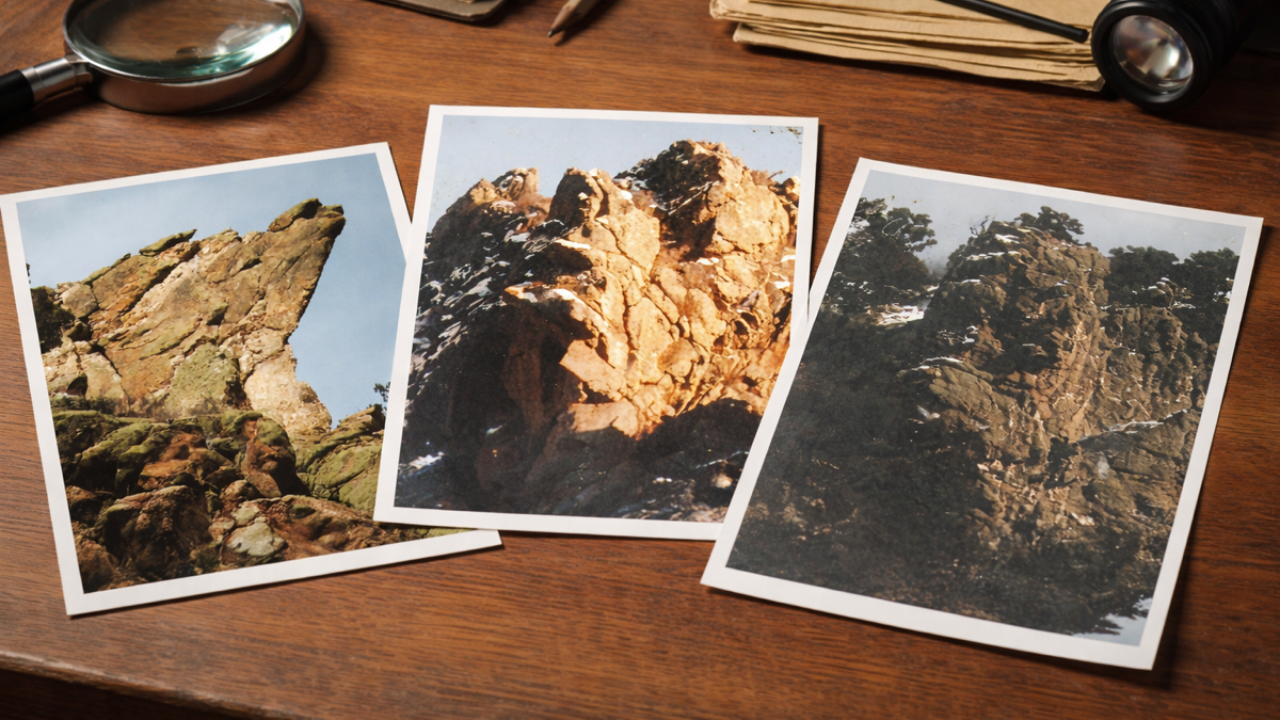
In the late 1990s, Robert Ghostwolf appeared on Coast to Coast AM with Art Bell and claimed he had discovered ruins from an ancient civilisation hidden somewhere in the Colorado Rockies. He did not describe buildings, settlements, or evidence of long-term habitation. What he said he found were carved figures set into natural rock faces, formations he believed had been deliberately shaped rather than the result of erosion.
According to Ghostwolf, the site featured figures positioned around an entrance. He described animal-like forms, including what he identified as griffins and sphinxes, along with humanoid faces emerging from the stone. One formation was described as a winged figure he identified as an archangel. He said the site was ceremonial in nature and suggested it belonged to a civilisation that predated known cultures in the region.
Ghostwolf was clear that he did not see these as vague resemblances. He named specific figures and described them as intentional sculptures. He said a pair of griffins flanked the entrance as guardians. Another formation was described as a sphinx-like figure, which he said was carved rather than naturally formed. The most prominent figure was identified as “Arch Angel Gabrielle,” described as a winged guardian marking what he believed was a significant threshold within the complex.
He also described the site as part of something larger, not a single carving or isolated feature, but a deliberately arranged complex tied to a specific location. In interviews, he spoke about gateways and boundaries, suggesting the carvings marked passage rather than habitation. What he did not describe were tools, construction methods, living areas, or artefacts connected to everyday use.
During his appearance on Bell’s show, Ghostwolf also described the location as a portal. He spoke about it as a boundary or gateway, marked and guarded by the carvings themselves. This was presented as part of the site’s purpose, not as evidence for how or when it was created.
Photographs were circulated online through Art Bell’s website and later archived elsewhere. They consist almost entirely of close-up images of rock faces showing shapes that can be read as faces or figures when viewed from a particular angle. No wider shots were provided to show the formations in their surroundings, and no precise location was ever made public.
Taken on their own, the photographs offer little to work with. There is no sense of scale, no clear reference points, and no way to judge whether the formations are small features in a larger outcrop or part of something more substantial. Without that context, it is not possible to determine whether the shapes are the result of deliberate carving, natural erosion, or visual interpretation. The images show surfaces, not sites.
What stands out is the certainty of Ghostwolf’s descriptions. He spoke of griffins, a sphinx, and the figure he identified as Arch Angel Gabrielle as deliberate sculptures, carved and placed with intent. Beyond the photographs themselves, there is nothing that allows those claims to be examined independently.
Claims of carved or constructed stone features in North America that fall outside the known archaeological record are not uncommon. Over the years, similar stories have focused on isolated rock formations described as statues, guardians, or remnants of lost civilisations. In most cases, the claims rely on interpretation and close-up imagery rather than associated material culture or repeatable structures.
When these claims have been examined formally, they tend to resolve in one of two ways. Either the features are shown to be natural formations shaped by erosion and weathering, or they are understood within known Indigenous traditions once proper context is established. What they do not produce are construction debris, tool marks, habitation layers, or artefacts that would support the existence of an unknown civilisation.
North America also has genuine ancient sites that were once misunderstood or underestimated. Mesa Verde initially puzzled early observers, but once examined properly it was clear what it was. The structures are extensive, repeatable, and supported by tools, pottery, habitation layers, and clear cultural continuity. The same applies to Cahokia, which was once dismissed as a natural landscape feature before excavation revealed a large, organised population centre.
Other confirmed sites followed a similar path. Serpent Mound and the Newark Earthworks were debated at times, but their scale, construction, and context could be demonstrated by independent researchers. Even when their purpose was unclear, their existence was not.
Ghostwolf’s Rocky Mountain claim never progressed beyond its initial presentation. There is no recorded site entry, no archaeological survey, no excavation report, and no follow-up work by professional archaeologists. Colorado’s archaeological record is structured and documented. Even when locations are restricted, discoveries leave a trace. In this case, there isn’t one.
After the radio appearances and circulation of photographs, the story went no further. No additional documentation emerged, no site was confirmed, and the claim faded from memory.
If an unknown ancient civilisation had left monumental carvings in the Colorado Rockies, it would not exist only as a handful of close-up images and decades-old radio transcripts. It would have left evidence that others could revisit. Instead, it stopped there, and the story was left to fade from memory.