
The Beatles Cassette From Another Reality: The Story of Everyday Chemistry
Mar 27, 2026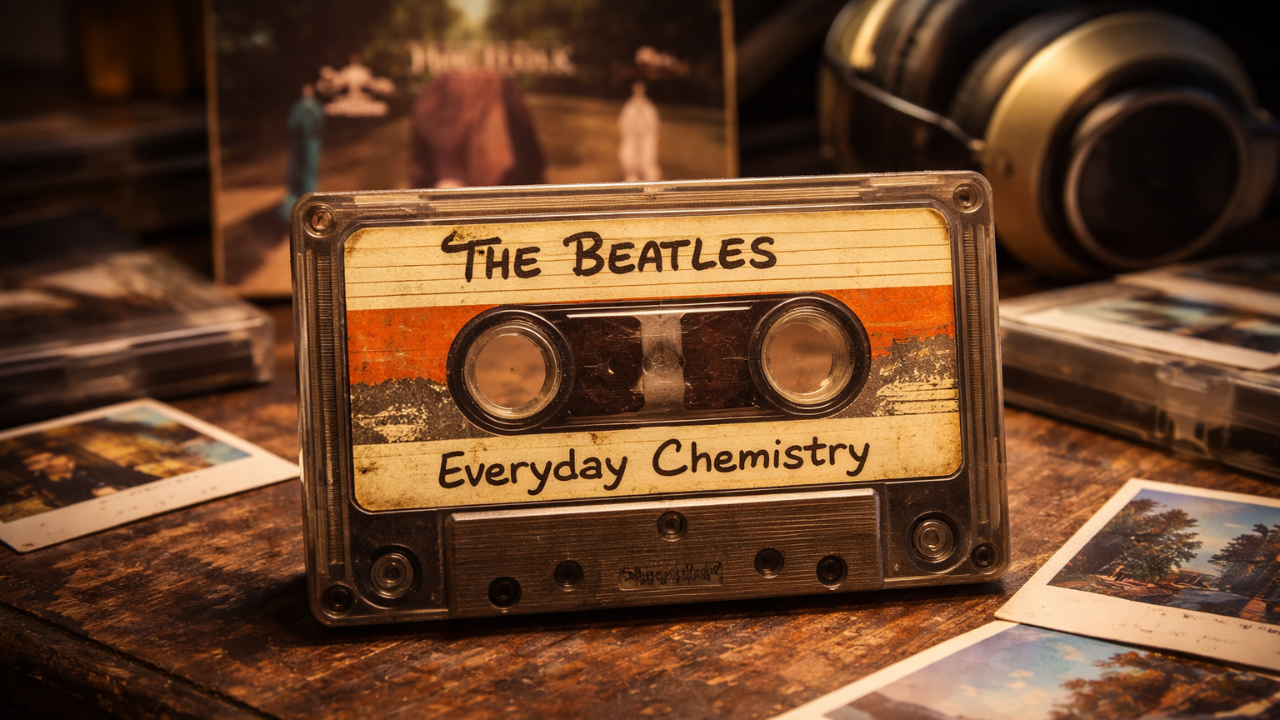
The idea of alternate realities did not begin on TV or in books. It came from physics. In 1957, physicist Hugh Everett proposed what became known as the Many Worlds interpretation. The theory suggests that when a quantum event has more than one possible outcome, each outcome may occur in its own branching universe. In practical terms, every possible outcome could exist somewhere.
It remains theoretical. There is no evidence that people move between these realities, and nothing in the theory suggests objects cross from one universe to another. Outside academic debates, the idea has taken on a different life. Popular culture has explored it for decades, from shows like Sliders to stories such as The Man in the High Castle, where small changes in history lead to entirely different worlds. Online, that same concept has become a part of modern folklore. It often overlaps with what is known as the Mandela Effect, where groups of people remember events differently from how they are recorded. People describe timeline shifts, misplaced memories, and small but unsettling differences in history.
Most of these stories follow a pattern. There is an accident or medical episode. A period of confusion. Then a discovery that something familiar has changed. In 2009, one such story surfaced involving a car crash, a supposed dimensional shift, and a cassette tape containing music by The Beatles from a universe where the band never broke up.
According to the man behind the claim, James Richards, everything began with a serious car accident. He said he lost consciousness and woke to find himself in a world that looked almost identical to his own, but not quite the same. The differences were subtle. Familiar places were still there, but certain details did not line up with what he remembered. Among those differences, he claimed, was the history of the Beatles.
In this version of reality, the band had never split in 1970. Instead, they continued recording together into the mid-1970s. Richards described hearing music he did not recognise, songs performed by John Lennon, Paul McCartney, George Harrison and Ringo Starr as a group, long after their real-world break-up. One of those albums, he said, was titled Everyday Chemistry.
Richards claimed he obtained a cassette copy of the album while in this alternate reality. He did not describe it as a master recording or official release, only as something he had access to and was able to take with him. He later said that he returned to his original reality, again without a clear explanation of how that transition happened, but this time with the cassette in his possession.
When he realised the album did not exist in this world, he decided to share it. The music was digitised and uploaded online under the name Everyday Chemistry, presented as a Beatles album from another timeline.
For listeners, the voices were unmistakable. The style felt familiar. But the songs themselves did not match any known Beatles release. For some, that was enough to keep the idea alive. The thought that somewhere the band had continued, recording music that never reached this version of history, gave the album a certain weight. As more people listened, the focus shifted to the music itself.
Parts of the recordings started to stand out. Certain vocal lines sounded recognisable. Instrumental sections carried a familiarity that became clearer with repeated listens. Gradually, listeners began identifying where those elements came from.
Sections of Everyday Chemistry could be traced back to solo work released after the Beatles split. Pieces of songs by Lennon, McCartney, Harrison and Starr had been edited together. Vocals from one track layered over instrumentals from another. Tempos adjusted. Keys aligned. The result was something that felt cohesive, but was built from existing material.
Once those connections were made, they were hard to ignore. What initially sounded like unknown recordings began to resolve into recognisable parts, rearranged rather than newly created.
The recordings themselves were the only evidence offered. There was no verifiable trace of the original cassette beyond the digital files that appeared online. No independent confirmation of its existence before that point. The story remained consistent in its outline, but unsupported beyond the music.
There are also parts of the claim that are left unexplained. The account suggests an accidental shift between realities, yet also involves the return with a physical object. How that object remained, when everything else aligned with this version of events, is not addressed. It is simply part of the story.
None of this answers the question of alternate realities. The theory itself remains part of ongoing scientific discussion. But the cassette, the album, and the claim attached to it can be examined on their own terms.
What you’re left with is a piece of music built from known sources, presented through a story that gives it a different meaning.
For some, that is enough to dismiss it. For others, the idea still holds a certain appeal. Not because of the evidence, but because of what it represents. A version of history where the Beatles never walked away, where the music continued, and where something lost here might still exist somewhere else.