
The Dark Side of the Moon: What People Thought Was Waiting There
Apr 08, 2026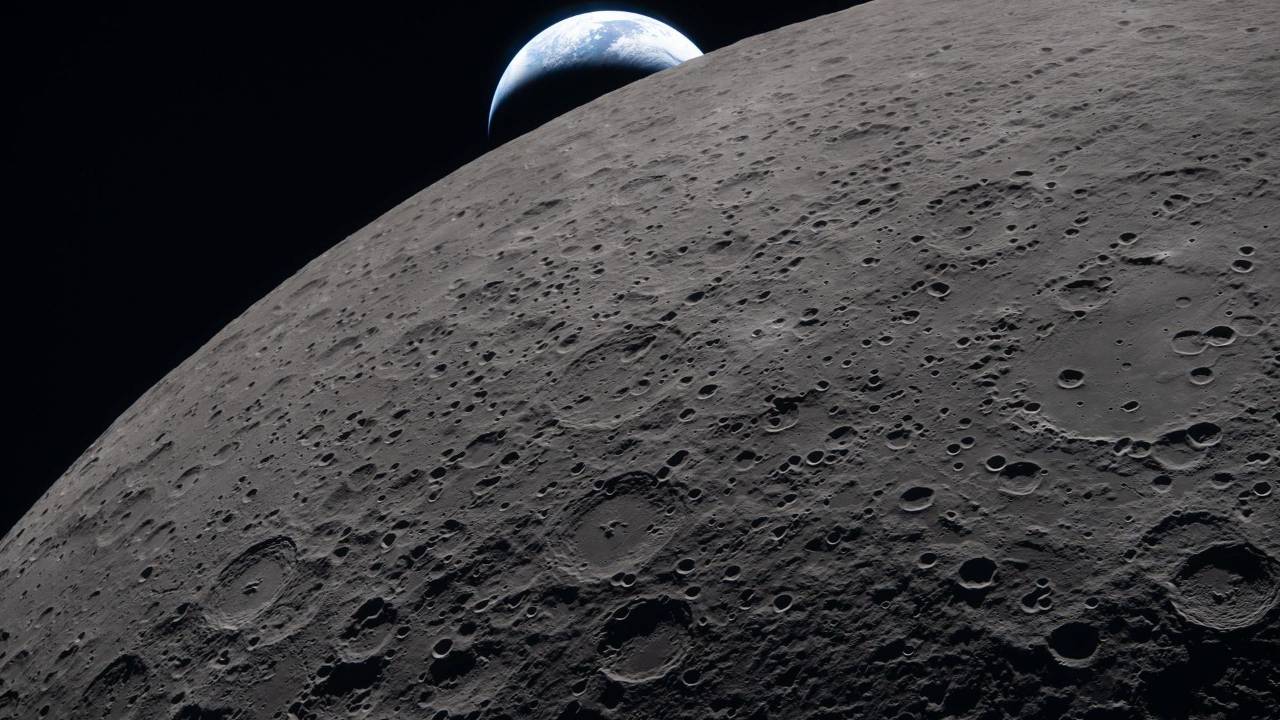
In April 2026, Artemis II carried a crew around the Moon and back again, passing behind it and briefly losing contact with Earth before returning with new images of the far side. It was a short mission, focused on testing systems rather than discovery, but it brought something back into view that hadn’t been seen directly by people in decades, the half of the Moon that never faces us.
For most of human history, that side wasn’t just distant, it was completely unknown. The Moon always shows Earth the same face, leaving the other hidden. Until the late 1950s, there was nothing to describe it beyond assumption. When the first images came back from the Soviet Luna 3 mission, they didn’t match what people expected. The wide, dark plains seen from Earth were mostly absent. In their place was a surface that looked rough, uneven, and heavily marked by impacts. It didn’t quite fit with the Moon people thought they knew.
Some of the earliest claims came directly from those images. The quality was poor, the angles unclear, and the shadows deep enough to distort the surface. Certain formations were picked out and examined more closely. A line of raised terrain became a wall. A shadow cast across a crater floor was taken as something vertical rather than flat. In a few cases, individual features were described as towers or structures standing above the surface. The details were never consistent, but the idea settled in quickly that something on the far side didn’t look natural.
As better images arrived through the 1960s and into the Apollo era, those interpretations didn’t disappear. They shifted. Instead of pointing to specific shapes, the focus moved toward the idea that something could still be there, just outside what was being shown. The far side became a place where activity could happen without being seen, not because there was evidence for it, but because there was no direct view from Earth.
During the Apollo missions, every crew that travelled around the Moon passed through the same period of radio silence as they moved behind it. For a short time, they were completely cut off. Claims began to circulate that something had been seen during those blackouts, that transmissions had been lost for reasons other than the Moon blocking the signal, or that conversations had taken place which were never released. There’s no record of anything like that happening, but the silence itself was enough to keep the idea in place. From there, the focus shifted toward something more permanent.
The far side of the Moon is often described as a base. Not a temporary presence, but something established. Reports of unidentified craft approaching the Moon and disappearing behind it are tied to that idea, with the suggestion that whatever is being observed isn’t passing by, but arriving. In some versions, the Moon itself becomes part of the explanation, acting as a natural shield that allows activity to continue without observation from Earth.
The same idea turns up in a different form. Hidden installations, long-term projects, experiments carried out beyond the reach of observation. During the Cold War, space was openly discussed as the next battleground, and the idea followed that something may have been placed on the far side long before the public had the ability to see it. Some accounts go further, tying it to older stories about advanced technology leaving Earth at the end of the Second World War and continuing somewhere out of reach.
One of the more persistent variations claims that remnants of Nazi Germany escaped at the end of the war and established a presence beyond Earth, with the far side of the Moon often named as the destination. In these versions, the Moon isn’t just a hiding place, it’s a working base, used for mining, construction, or the continued development of advanced technology. The details change depending on who’s telling it. Some describe fleets leaving Antarctica. Others tie it to experimental aircraft that were never fully accounted for. There’s no evidence for any of it, but the idea has held on, largely because it takes a real moment in history, the collapse of Nazi Germany, and extends it somewhere it can’t easily be checked.
Then there’s the Apollo 20 story, one of the more detailed versions of all of this. According to the claim, a joint Soviet-American mission was sent to the Moon in the 1970s and discovered a large, derelict craft resting on the surface. Inside, a preserved humanoid figure was found, described as female and referred to as “Mona Lisa.” Images and video clips were released years later, showing the interior of the craft and the figure itself. The footage was convincing enough to spread quickly, but it was eventually traced back to fabricated material and a hoax. Even so, the story still surfaces, usually presented as something worth taking another look at.
For a long time, no one could see that side of the Moon at all. Artemis II doesn’t change that history, but it does add to it. The images returned from the mission show the far side in the same way modern lunar orbiters already have, a surface shaped by impacts, time, and geology, with nothing to suggest structures or activity beyond that. There’s nothing in those images that supports the claims that have built up around it.
New images don’t end the stories, they give people something else to work with. A shadow in a different place. A ridge seen at a different angle. The same process repeats, just with clearer detail.
The far side of the Moon is no longer unknown in the way it once was, but it was for long enough that people decided what it meant before they ever saw it. And once that idea is in place, it doesn’t disappear. It just waits for the next image to be looked at again.