
The Green Children of Woolpit: From the Underground Land of St. Martin
Dec 01, 2025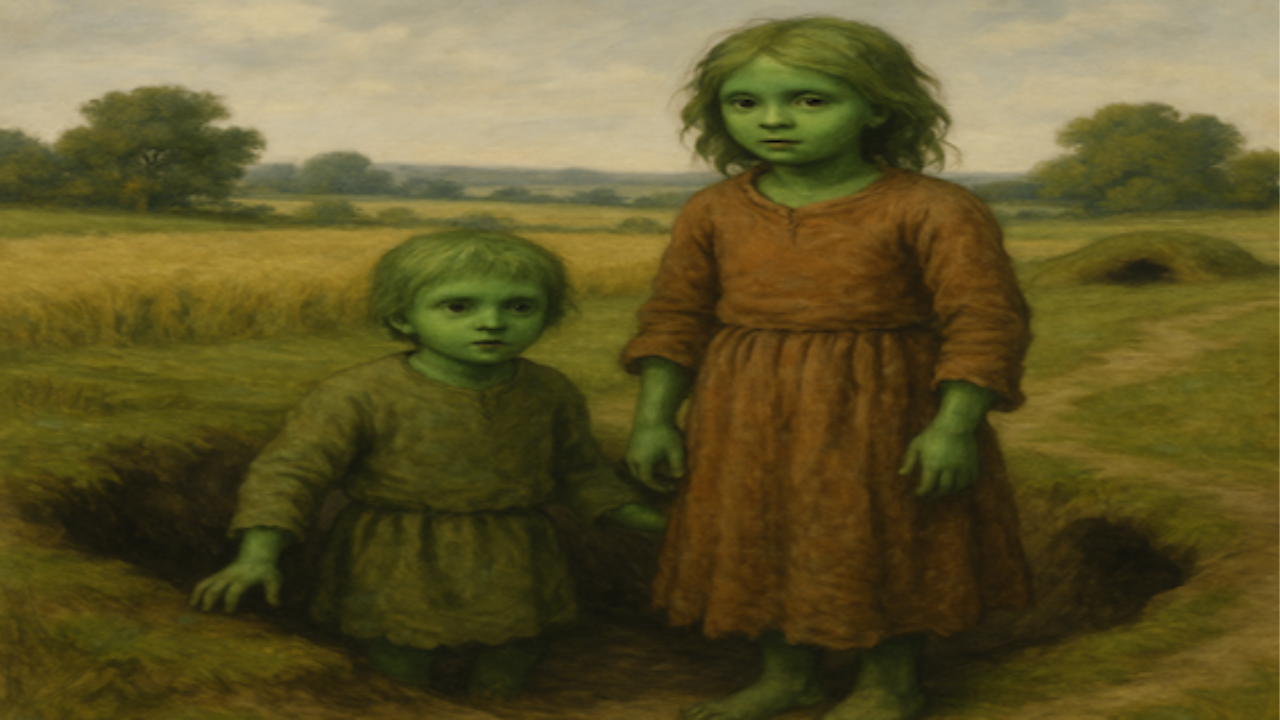
Woolpit was a small farming community, much like any other in that part of Suffolk. It was surrounded by fields and known for the deep wolf pits on its outskirts. In the twelfth century, villagers said two children appeared near those pits with green-tinted skin and a language no one recognised.
The children were found by reapers working the fields near the pits. They stood at the edge of one of the hollows, unsure of where they were, and wouldn’t approach until the workers coaxed them out. They wore unfamiliar, rough-spun clothing and seemed disoriented. Witnesses said they cried at first and refused almost everything offered to them. When someone gave them raw broad beans, they recognised them immediately and ate them straight from the pods.
Their language drew as much attention as their appearance. Villagers tried speaking to them in several dialects common in the region, but nothing was understood. The words they used were unlike anything the locals recognised, and the children did not seem to understand any of the responses they were given.
A local landowner, Sir Richard de Calne, took them in. Under his care, the children slowly adapted to a normal diet, and the green tint to their skin faded. The boy, who appeared younger and weaker, died not long after. The girl survived and eventually learned English well enough to explain what she remembered.
She said she and her brother came from a place she called St. Martin’s Land, a dim world where the light never reached full brightness, as if it were always early evening. She said everything there had the same muted look, including the people, who shared the same green colouring she and her brother had when they first arrived in Woolpit. She also described a large river dividing their land from a brighter world across the water. She said she and her brother were tending their father’s livestock when they heard a loud sound that seemed to come from beyond the river. They followed it, became disoriented, and somehow found themselves near the wolf pits without understanding how they had travelled so far.
The girl stayed in Woolpit and nearby communities. She was baptised, worked within Sir Richard’s household, and later married a man from King’s Lynn in Norfolk. She lived the rest of her life in the region and never added more to the memories she had already shared.
Several explanations have been put forward over the years. One common idea is that the children were Flemish refugees displaced by violence in the region. In 1173, the Battle of Fornham took place about thirty miles from Woolpit, and Flemish settlers living nearby were attacked during the unrest. Children separated from their families, wandering through dense woodland and marsh, could easily have ended up in an unfamiliar village speaking a dialect no one recognised. Malnutrition can also create a greenish tint that fades with a better diet. These ideas answer some parts of the story but leave others unresolved, including the girl’s description of a land in perpetual dimness and the river she remembered clearly.
Ralph of Coggeshall and William of Newburgh, the men who first wrote down the incident, were known for documenting real events of their time. They described the children in the same straightforward tone they used for other accounts, without exaggeration or symbolic language.
There is a clear difference between the earliest records and the details added later. The children’s arrival, their behaviour, the unfamiliar language, and the girl’s account of St. Martin’s Land come from the original medieval sources. Her baptism, marriage in King’s Lynn, and suggestions about children appeared in later attempts to trace her life. Some retellings even assigned her the name “Agnes” and linked her to a woman named Agnes Barre in Norfolk, though none of this can be confirmed.
Because the early accounts and later additions never fully match, the case has remained open to interpretation. With limited testimony, conflicting clues, and unanswered questions that have never been resolved, the story continues to draw interest centuries later. The Green Children of Woolpit remain one of England’s most persistent medieval mysteries.