
The Third Man Syndrome: Who Pulled Dale Earnhardt Jr. From the Fire?
Sep 14, 2026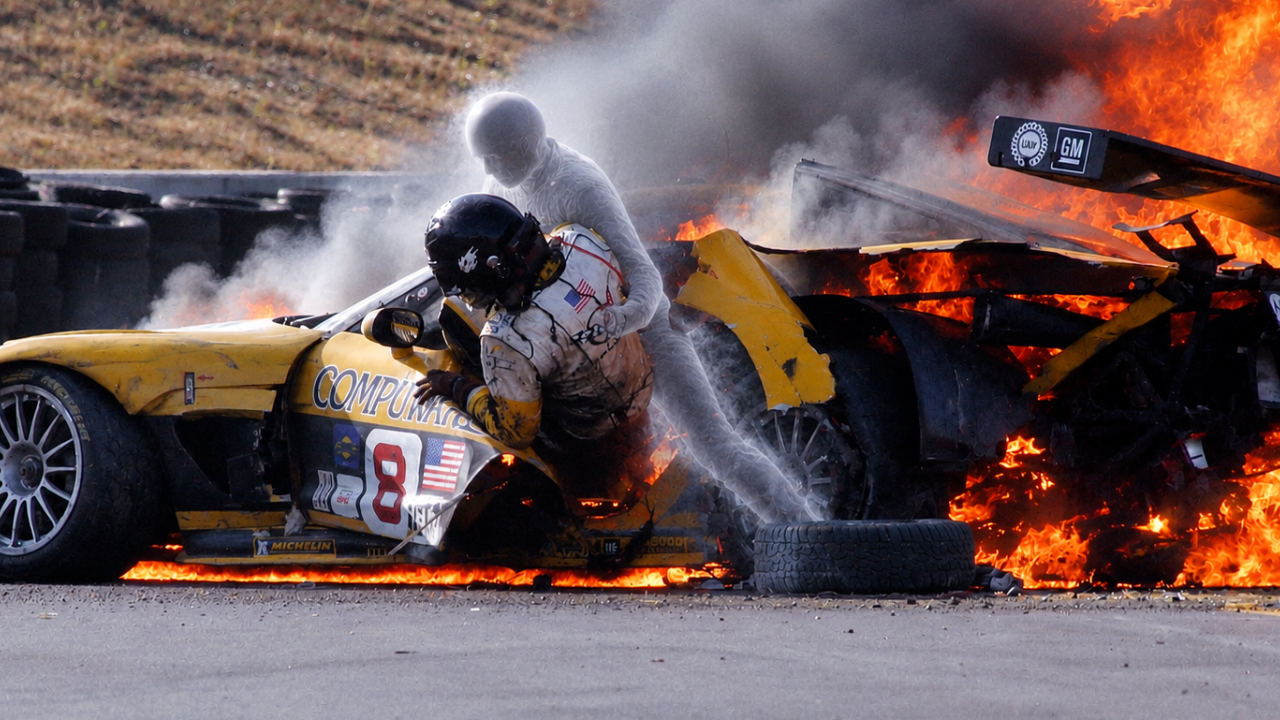
Dale Earnhardt Jr. is one of the best-known names in American motorsport. The son of seven-time NASCAR Cup Series champion Dale Earnhardt Sr., he followed his father into racing and went on to win the Daytona 500 twice during a career that eventually earned him a place in the NASCAR Hall of Fame. His father had been killed during the final lap of the Daytona 500 in 2001, but three years later, Earnhardt Jr. would survive an accident that left him with a story he still cannot fully explain.
In 2004, Earnhardt was trapped inside a burning race car following a crash in California. As he struggled to escape the flames, he later said he felt someone grab him underneath his arms and help pull him to safety. When he asked who had helped him, he was told that nobody had been there. The experience would later raise an extraordinary question: had his father somehow played a part in his escape?
The incident happened on July 18, 2004, during a morning warm-up session at Infineon Raceway in Sonoma, California. Earnhardt was driving a Chevrolet Corvette C5-R in preparation for an American Le Mans Series race when he spun at Turn 8 and slid backwards into a concrete barrier. The impact broke the fuel filler neck and the Corvette quickly became surrounded by flames.
The fire spread incredibly quickly. CBS later reported that a temperature sensor inside the Corvette went from around 115°F to 750°F in approximately a second and a half before the sensor failed. It took Earnhardt around fourteen seconds to escape. He suffered second-degree burns to his legs, chin and neck and spent the night at UC Davis Medical Center.
It was during those fourteen seconds that Earnhardt says something happened that he couldn’t explain. While trying to escape the burning Corvette, he felt someone physically grab him underneath his arms and help pull him from the car. He initially assumed that someone working at the circuit had reached him and helped him escape, but when he asked who had pulled him out, he was told there had been nobody there.
During a 2004 interview with Mike Wallace for 60 Minutes, Earnhardt said that after the accident he grabbed his PR representative by the collar and demanded that he find the person who had pulled him from the car. His representative told him that nobody had. The footage of the accident shows Earnhardt getting out of the Corvette with nobody beside the car helping him.
Earnhardt himself has been more cautious about the possibility that his father was somehow responsible than some versions of the story suggest. During his 60 Minutes interview, he said, “I think he had a lot to do with me getting out of that car. Absolutely.” But he stopped short of claiming that his father’s ghost had physically rescued him. “I don’t want to put some weird psycho twist on it, like he was pulling me out or anything,” he explained. Whatever Earnhardt believed had happened, the experience was still affecting him just over two months later. “It freaks me out today just talking about it. It just gives me chills.”
The experience was something Earnhardt continued to talk about. During a 2018 episode of the Dale Jr. Download podcast, the conversation turned to ghosts and the paranormal. Earnhardt said he believed there was more to people than “just blood vessels, and bone and muscle” and was open to the possibility of haunted places, although he said he had never actually seen a ghost.
He then returned to what happened at Sonoma. Earnhardt remembered beginning to lean forward to climb from the Corvette before feeling something grab him underneath his armpits, pull him over the door bars and then let him go. He was adamant about how physical the experience had felt. “It was a hand! It was physical hands grabbing me! I felt it.”
Fourteen years after the accident, Earnhardt still couldn’t explain what had happened, but he wasn’t claiming to know that it was paranormal either. He described the Sonoma accident as probably the closest thing to a paranormal experience he had ever had, before adding: “if it’s real.”
That is Earnhardt’s story, and the most important part of it is that he has never claimed to know exactly what happened. He remembers the physical sensation of hands pulling him from the Corvette, while the images and footage show nobody there. There are, however, parts of his recollection that changed as the years passed.
Five days after the accident, Earnhardt spoke to reporters at New Hampshire International Speedway and was asked what he remembered. “I remember everything about the wreck,” he said, before describing remembering sliding, hitting, bursting into flames, climbing out, crawling away, getting up and being placed on a stretcher.
Just over two months later, during his interview with 60 Minutes, Earnhardt’s description was slightly different. He described a period he couldn’t remember, beginning when he started unbuckling his safety belt and ending when he found himself on the stretcher. When he spoke about the accident again ten years later, his recollection contained more detail. He remembered getting himself as far as the door and climbing onto it, only for the door to collapse beneath him because it was melting. He then remembered the feeling of someone grabbing him and pulling him the rest of the way out, but said he couldn’t remember what happened between the door collapsing and finding himself on a table in the infield care centre.
The fact that Earnhardt’s memory of the accident changed doesn’t mean that he was lying or that he invented the experience later. He had just survived a violent crash and found himself trapped inside a burning car. There is also a difference between remembering the general sequence of an event and remembering every individual moment within it. Earnhardt may have remembered that he climbed from the car without having a clear memory of every second involved in doing so.
Whatever caused the differences in his accounts, the basic story of someone pulling him from the Corvette was already there in 2004. This wasn’t something Earnhardt first remembered years later. He was asking his PR representative who had helped him shortly after the crash and was publicly talking about it just over two months later.
Earnhardt is not the only person to report the sensation of an unseen presence helping during a life-threatening situation. Experiences like this are sometimes referred to as the Third Man Factor, in which people facing extreme danger report sensing another person or presence alongside them, sometimes offering encouragement, guidance or even physical help.
One of the more remarkable examples came from Ron DiFrancesco, who was inside the South Tower of the World Trade Center during the September 11 attacks. Trapped by smoke and fire and struggling to escape, DiFrancesco later recalled hearing a male voice calling him by name and telling him to get up. He also described feeling as though “somebody lifted me up” and guided him towards an escape route. DiFrancesco eventually made it out of the tower shortly before it collapsed and described the presence that helped him as an angel.
Similar experiences have been reported by people in other extreme situations. Explorer Ernest Shackleton wrote of sensing an additional companion during the desperate crossing of South Georgia in 1916, despite knowing there were only three men in his party. Afterwards, Frank Worsley and Tom Crean admitted that they had experienced something similar. Mountaineer Reinhold Messner also described sensing another climber during his disastrous descent of Nanga Parbat in 1970, during which his brother Günther died.
There could, of course, be another explanation for experiences like these. Extreme danger can affect awareness and memory, and Earnhardt himself wondered whether shock had played a part. When discussing the accident in 2014, he admitted that he didn’t understand why parts of the experience were missing from his memory, adding, “Maybe I was in shock or something.”
There is also evidence that the brain can create the feeling that another person is there. In 2014, a team led by neurologist Olaf Blanke managed to recreate something similar in healthy volunteers. Participants moved a robotic device with their hands while another robot reproduced those movements by touching their backs. When a short delay was introduced between the movement and the touch, some began to feel as though another person was standing behind them. Some even felt that the unseen presence was touching them.
The experiment showed that when what someone does and what they feel don’t quite match, the brain can create the sensation that somebody else is nearby. Something similar could have happened to Earnhardt. He was trying to climb from a burning car while in extreme pain and fear, and some of the physical sensations involved in getting himself out could have felt as though they were coming from somebody helping him.
That doesn’t mean this is what happened. Earnhardt may genuinely have felt hands underneath his arms. The question is what caused him to feel them.
What we do know is that Earnhardt escaped from a burning Corvette and remembers someone helping him do it. The footage shows nobody beside the car pulling him out. Perhaps his brain, under extreme stress, created the feeling that someone was there. Perhaps there was something more to it. More than twenty years later, Earnhardt’s experience remains something he cannot fully explain.